7 Things Most People Only Learn Too Late About Cremation Urns
When people begin looking for a cremation urn, they often assume the choice will be fairly simple. They expect to compare a few designs, pick the one that looks most appropriate, and move on. In reality, that is rarely how the process feels.
Choosing an urn often brings up practical and emotional questions at the same time. How much ash will it hold? Does it need to be permanent? Can ashes be divided? Should the urn be displayed, buried, stored privately, or used later for scattering? For many families, these are not questions they considered beforehand. They only arise once decisions already need to be made.
That is why cremation urns tend to be misunderstood. People often think of them as a final container, when in practice they are part of a wider process of remembrance, timing, and personal choice. The most helpful thing families can learn is that there is usually more flexibility than they first expect.
Below are seven things about cremation urns that many people only discover once they are already in the middle of the process. Knowing them earlier can make the entire decision feel calmer, clearer, and far less rushed.

1. Urn size is about ash capacity, not how large the urn looks
This is one of the most common surprises. Many people assume they can judge an urn by its appearance alone. They see something that looks large enough and reasonably solid, only to find out later that the internal capacity is too small for the full ashes.
The usual guideline is to allow around one cubic inch of ash for every pound of body weight. That means a full size adult urn will often need a capacity of approximately 180 to 220 cubic inches. It is not an exact formula, but it is the standard rule of thumb that helps families avoid choosing purely by appearance.
What makes this confusing is that outer size can be misleading. Two urns may look similar from the outside while offering very different internal volume. Shape, wall thickness, base structure, and decorative design all affect how much space is actually available inside.
That matters especially when comparing a full size urn with a keepsake urn, a child urn, or a companion urn. The proportions may look closer than they really are. The stated capacity tells you far more than the outside dimensions ever will.
For that reason, many families prefer to choose an urn with a little extra room rather than selecting one that only just seems sufficient. In practice, that small allowance often gives far more reassurance than a perfectly exact measurement.
If you would like a more detailed breakdown of ash volume, standard urn capacity, and general sizing estimates, you can read our guide on "how much ash is left after cremation and what size urn you may need".
2. You are usually not limited to the urns offered by the funeral home
Another thing people often discover only later is that the urn shown by the funeral home is not necessarily the urn they must choose. In many cases, families are free to buy an urn elsewhere and take more time to find something that suits them better.
This matters because funeral homes often offer a relatively limited selection. The available urns may be practical and appropriate, but they are not always personal, distinctive, or well suited to the place where the urn will eventually be kept. Some families want a more contemporary style. Others want something more understated, more artistic, or more in keeping with the home.
There is also an emotional reason why this matters. Decisions made under pressure often feel different later. An urn is not simply a functional purchase. It may become part of a daily environment, a visible place of remembrance, or something that quietly holds meaning for years. People often feel better when they know they had the freedom to choose rather than simply accept the first available option.
In many cases, ashes are first returned in a temporary container. That alone removes a great deal of pressure. It means families can pause, think carefully, and choose a permanent urn when the first rush of arrangements has passed.
3. The most important question is not what looks best, but what the urn is meant to do
People naturally start with design. That is understandable. The shape, colour, and finish are the first things you notice. But the most useful starting point is not appearance. It is purpose.
An urn for display at home is not the same as an urn intended for burial. An urn for scattering is not the same as one meant for long term indoor keeping. A small memorial urn is not the same as a full size urn for all of the ashes. Yet many families begin by looking at style and only later realise that function should have guided the decision from the beginning.
If the urn will remain in the home, you may need to think about stability, durability, and how it will sit within the room. If it will eventually be buried or placed in a columbarium niche, the cemetery or memorial site may have specific requirements for size, material, or type. If the ashes will later be scattered, a dedicated scattering urn may be much easier to use than a decorative urn designed mainly for display.
This is why a beautiful urn is not automatically the right urn. The best choice is usually the one that fits the plan for the ashes and the reality of how the memorial will be lived with over time.
If you are still comparing standard, extra-large, companion, or keepsake options, you may also find it helpful to read our guide on "how to choose the right size cremation urn".

4. Not every urn is meant to be permanent
Many people assume that placing ashes into an urn is a final step. In reality, that is not always the case. Some urns are chosen for temporary use, and some families later decide to move the ashes into another urn that feels more appropriate.
That can happen for very understandable reasons. In the first days or weeks after a cremation, people are often making decisions while emotionally overwhelmed. What feels acceptable in that moment may not be what feels right several months later. A family may move house. A memorial space may change. Relatives may decide to divide the ashes after all. Or someone may simply realise that the first urn was chosen too quickly.
Knowing that the first urn does not always have to be the final urn can be deeply reassuring. It allows people to treat the decision as something that can unfold in stages rather than something that must be settled perfectly all at once.
Biodegradable urns are another example of this. They are intentionally designed for a different purpose. Their role is not long term keeping, but natural burial or water release, where impermanence is part of the meaning.
A temporary urn is therefore not a lesser option. In many situations, it is the most sensible and most compassionate choice because it gives space for a more considered decision later.
5. Ashes can be divided, and many families find that comforting
A surprising number of people still assume that all ashes must remain together in one urn. That is one possible choice, but it is far from the only one. In many families, dividing the ashes feels more realistic and more meaningful.
This often happens when several close relatives want their own place of remembrance. One person may keep the main urn, while others receive a keepsake urn or a small amount of ashes in memorial jewellery. In families spread across different cities or countries, this can be especially important.
Dividing ashes can also help when a family wants more than one form of remembrance. Part may remain in a main urn, part may be scattered in a meaningful place, and part may be kept privately in a smaller memorial item. For many people, that reflects the reality of grief better than one single permanent arrangement.
It is worth saying clearly that this does not make remembrance less serious. It often does the opposite. It acknowledges that grief is shared, that relationships are different, and that memory does not always belong in one form alone.
6. The material affects daily practicality just as much as appearance
Material is often treated as a design preference, but its practical effect is just as important. The way an urn feels in a room, how securely it can be kept, how durable it is, and how appropriate it remains over time are all shaped by material.
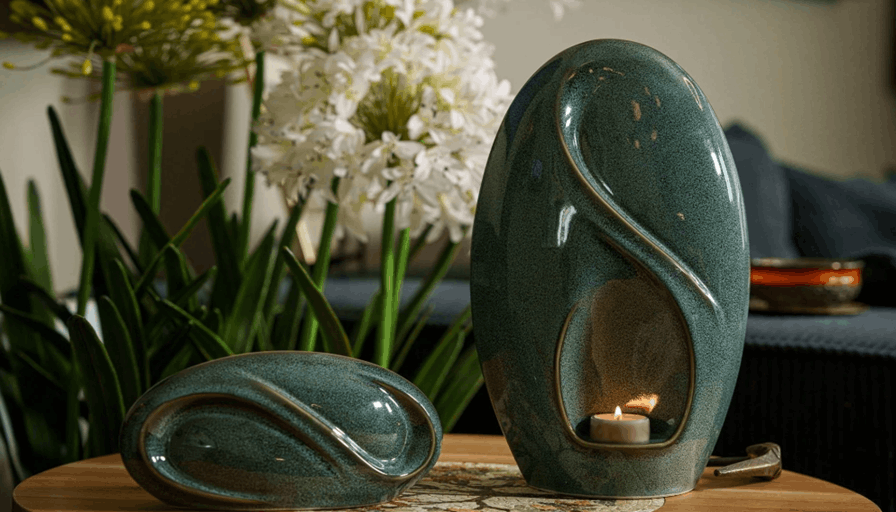
Ceramic urns are often chosen for their artistic and refined appearance. They can create a very beautiful presence in a stable indoor setting, especially where the urn will remain undisturbed. At the same time, they may be less suitable in households where the urn could be moved often or knocked accidentally.
Metal urns tend to offer a greater sense of strength and permanence. Many families find that reassuring. Wooden urns often feel softer and more natural in a domestic setting. They may blend more gently into the home and feel less formal. Biodegradable urns, by contrast, are chosen for a completely different reason, usually because the intention is burial or scattering in a natural way.
This is why material should always be considered in context. The right question is not simply which material looks best. It is which material suits the intended setting, the level of handling, and the kind of remembrance the family has in mind.
7. You usually have more time than you think
Perhaps the most important thing families learn is that they often do not need to decide as quickly as they fear. In the first days after a death, everything can feel urgent. That emotional pressure makes people assume the urn must be chosen immediately. In many cases, that simply is not true.
Ashes are often returned in a temporary container when a permanent urn has not yet been selected. That gives families time to move beyond the first practical rush and think more clearly about what they actually want. Once that pressure falls away, people often make different decisions.
A family that first imagined one decorative urn may later decide that sharing the ashes feels more appropriate. Someone who thought they wanted an elaborate design may later prefer something quieter and more timeless. Others decide not to choose a permanent urn until months later, when the decision feels less tied to immediate shock and more connected to lasting remembrance.
Taking time does not mean avoiding the decision. In many cases, it means treating the decision with the seriousness it deserves.

How to choose the right cremation urn
Once the pressure is reduced, the process usually becomes far easier. The most helpful approach is to answer a few practical questions in the right order.
Start with the ashes themselves. Will all of the ashes remain together, or will they be divided? Are you looking for a full size urn, a keepsake urn, or something intended for later scattering?
Then think about location. Will the urn be displayed in the home, kept privately, buried, placed in a niche, or used only as a temporary solution? The setting will immediately narrow what is sensible.
Next, consider material. A ceramic urn may be visually beautiful, but it may not suit every household. A metal urn may provide greater reassurance for long term keeping. A wooden urn may feel more natural and less formal. A biodegradable urn may be the right choice when permanence is not the goal.
Only after that should design take the lead. The best urn is rarely the most striking one in isolation. It is the one that feels appropriate in relation to the ashes, the setting, and the person being remembered.
Common misunderstandings about cremation urns
Several assumptions continue to make the process harder than it needs to be.
One is that the urn must be purchased immediately. In reality, there is often more time than families expect.
Another is that the funeral home selection is the only selection. That is usually not the case.
Many people also assume that all ashes must remain together in one container. In practice, dividing ashes is common and often deeply meaningful.
There is also a tendency to believe that a more expensive urn is automatically more respectful. It is not. Respect is not measured by price, but by suitability, care, and intention.
And perhaps most commonly of all, people assume that size can be judged by sight. In practice, the stated capacity, the purpose of the urn, and the way it will be used matter much more than appearance alone.
Frequently asked questions
How do I know what size urn I need?
A common guideline is to allow about one cubic inch of ash for every pound of body weight. If you are unsure, choosing a slightly larger urn is usually the safer option.
Can ashes be transferred from one urn to another later?
Yes, in many cases they can. That is one reason some families begin with a temporary urn or container and make a more permanent choice later.
Are cremation urns permanently sealed?
Not always. Some urns are intended to be sealed, while others have closures that allow later access if needed.
Are ashes placed loose inside the urn?
Not always. In many cases, the cremated remains are first placed in a sealed inner bag and then set inside a temporary container or the chosen urn. That can also make later transfer easier.
Is cremation jewellery a practical option?
Yes. It is designed to hold only a very small symbolic amount of ashes, making it suitable as a personal memorial rather than a replacement for a full size urn.
Are there urns made specifically for scattering?
Yes. Scattering urns are designed to make the process more controlled and easier to manage, which can be especially helpful during an emotional moment.
Final thoughts
Most people do not begin this process with a detailed understanding of cremation urns, and there is nothing unusual about that. The difficulty usually comes from thinking the decision is more immediate, more fixed, and more straightforward than it really is.
In practice, choosing an urn involves several connected decisions about size, purpose, material, timing, and remembrance. Once those elements are understood, the entire process tends to feel less overwhelming. Families often realise they have more freedom, more flexibility, and more time than they first believed.
That is what makes good information so valuable here. It does not remove grief, but it can remove unnecessary uncertainty. And that often allows people to make a choice that feels calmer, more personal, and more fitting in the long term.
If you still have questions after reading this guide, or if you would like help choosing a suitable urn, you are welcome to contact us via our contact form.