How Many Cremation Urns Can Be Buried in One Grave?
There is no single nationwide limit on the number of cremation urns that can be buried in one grave in the Republic of Ireland. Two, four or more sets of cremated remains may be permitted, depending on the burial ground and the particular grave.
Some burial authorities take a flexible approach to multiple ashes interments. Others may apply restrictions based on the grave's available space, previous burials, burial rights or local regulations.
The important distinction is between the number of urns that might physically fit into a grave and the number of cremated remains interments the burial-ground manager will authorise.
Quick answer: More than one urn may share a grave in Ireland, but no fixed number applies everywhere. Fingal County Council, for example, does not specify a numerical maximum in its published cemetery FAQ. Families should still confirm what is permitted in the particular grave before arranging an interment.
What Do Irish Cemetery Authorities Say About the Number of Urns?
The number of permitted ashes interments can differ between burial authorities and individual graveyards.
In Ireland, local authorities operate many public burial grounds, while parishes and community organisations also manage graveyards. The organisation responsible for a particular burial ground is therefore the appropriate place to confirm its rules.
This division of responsibility is explained in the Irish Government's guidance on burial regulations.
Fingal County Council: A Flexible Approach
Fingal County Council provides a particularly useful example of how coffin burials and cremated remains may be treated differently.
In its published cemetery frequently asked questions, Fingal explains that most of its relevant grave spaces accommodate two or three coffin burials, although part of St Fintan's Cemetery in Sutton can accommodate four coffins.
Yet when answering the question of how many cremated remains may be placed in a grave, the council states:
Fingal County Council: "As many as you wish."
This illustrates an important point: a limit on coffin burials does not necessarily establish a corresponding limit on cremated remains interments.
However, the wording should not be understood as permission for anyone to open a grave or place unlimited urns without approval. Families should still contact the cemetery office to confirm the arrangements for the particular grave.
Official source: Fingal County Council - Operations FAQs.
Does Fingal's Policy Apply Throughout Ireland?
No. Fingal's published answer is an example of one local authority's approach, not a rule applying to every cemetery or graveyard in the country.
Other burial grounds may have their own requirements concerning the number of interments, access to an existing grave, authorised burial rights and the containers that may be used.
A family grave in County Dublin should therefore not be assumed to have the same conditions as one in Cork, Galway, Limerick or another county.
Where the cemetery's published information does not give a numerical limit, ask its administrator to confirm the permitted capacity of the particular grave.

What Determines How Many Urns Can Be Buried in a Grave?
Grave capacity is not simply a question of size. Several practical and administrative factors influence whether multiple sets of ashes may share the same resting place.
| Factor | Why it matters |
|---|---|
| Type of grave | A traditional family grave and a dedicated ashes plot may have different arrangements for cremated remains. |
| Existing burials | Previously interred coffins, urns or loose ashes may affect the available space and future arrangements. |
| Physical conditions | Grave depth, existing structures and ground conditions can influence whether another interment can take place safely. |
| Burial rights | The appropriate person must be entitled to authorise use of the grave. |
| Local regulations | The burial-ground manager may impose conditions on the number of interments or the way ashes are buried. |
| Urn dimensions | Large containers may require more space, even where additional interments are permitted. |
These considerations help explain why two apparently similar family graves may not have the same remaining capacity.
Most importantly, available physical space does not automatically mean that another burial is authorised.
Can Two Cremation Urns Be Buried Together in Ireland?
Yes, where the burial ground permits two sets of cremated remains to be interred in the same grave.
This may be chosen by spouses, partners, siblings or other relatives who wish to share a resting place.
Families generally have two container options.
Two Separate Urns
Each person's ashes are placed in an individual urn. The two containers may be buried together or at different times, provided the cemetery approves the arrangements.
Keeping the ashes in separate containers may also make planning easier when the interments take place many years apart.
One Companion Urn for Two People
A companion urn is designed to hold the cremated remains of two individuals, either in separate compartments or within one shared chamber.
However, one container does not necessarily count as one interment under cemetery procedures. The burial-ground manager may need to identify and record both individuals.
Before purchasing a companion urn for burial, confirm whether the cemetery accepts a shared container and whether there are restrictions on dimensions or construction.
You can explore our companion urns for two people once the requirements are clear.
Can Four, Six or More Sets of Ashes Share One Grave?
Potentially, but families should not assume that any particular number is permitted throughout Ireland.
Fingal County Council's published guidance shows that a burial authority may take a more flexible approach to cremated remains than to coffin burials.
Nevertheless, this does not establish a general right to inter four, six or any other number of people in every Irish family grave.
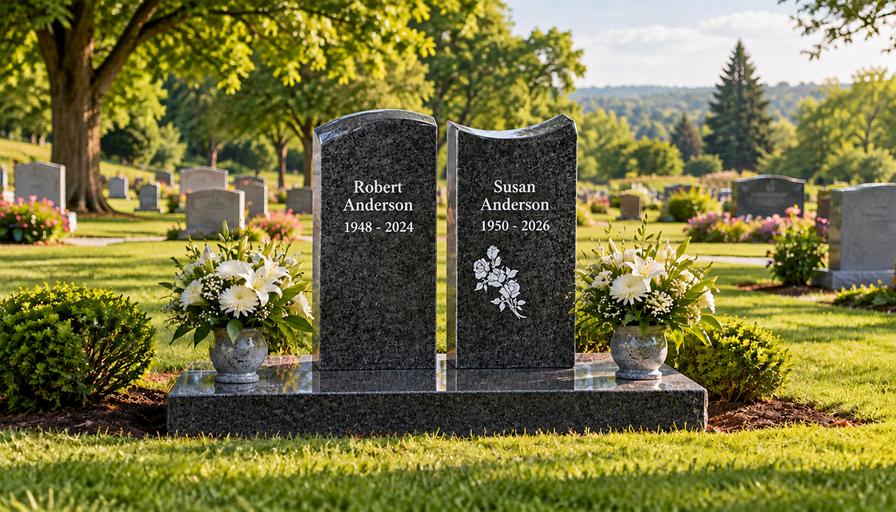
For example, a family may wish to arrange a shared resting place for two parents and several adult children, with individual ashes interments taking place over many years.
Before making those arrangements, the burial-ground manager should confirm whether future interments will be permitted and how the grave's capacity and burial rights will be recorded.
For families planning ahead: Ask whether the burial ground has a maximum number of cremated remains interments, whether any previous burials restrict further use and who can authorise future interments.
Does the Type of Grave Affect the Number of Urns Allowed?
Yes. The arrangements for traditional graves and spaces designed specifically for cremated remains may differ.
Traditional Family Graves
A traditional family grave may already contain one or more coffin burials. Depending on the graveyard's rules, cremated remains may also be interred there.
The number of additional urns that can be accommodated depends on the particular grave and the permission granted by the burial-ground operator.
Dedicated Ashes Plots
Some cemeteries offer smaller plots specifically for cremated remains. These may be intended for one person, two people or several family members, depending on the site.
Not every Irish cemetery offers dedicated ashes plots, and the number of permitted interments should be confirmed before purchasing burial rights.
For a broader comparison of family graves, cremation plots, columbaria and memorial gardens, read our guide to urns and ashes in cemeteries in Ireland.
What If the Family Grave Already Contains Coffins?
A grave containing one or more coffins may still be considered for the interment of cremated remains, depending on the burial ground's rules and the condition of the particular grave.
However, an existing coffin burial does not automatically establish how many additional sets of ashes will be permitted.
If the cemetery has already described the family grave as full, the situation requires a more specific assessment.
Our separate guide, Can ashes be buried in a full family grave in Ireland?, explains what families can do when a grave may no longer accept another coffin burial or when permission for an additional interment is uncertain.
Can Several Family Members Share One Grave Over Time?
Sometimes. Where further cremated remains interments are permitted, a grave may provide a shared resting place for family members who die years or decades apart.
The important step is to establish the arrangements before relying on the grave for future burials.
Ask whether the burial-ground operator can record the intended future use, whether any capacity can be reserved and who will be able to authorise a later interment.
It is helpful to keep written confirmation with the family's important documents, particularly when burial rights may need to pass to another person.
Does a Smaller Urn Increase the Number of Burials Allowed?
Not automatically.
A compact urn may occupy less space than a large decorative or companion urn, but its size does not override burial-ground rules or authorisation requirements.
The cemetery may also have conditions concerning the material, construction or external dimensions of burial containers.
Before selecting an urn, ask for the maximum permitted height, width and depth, together with any specific material requirements.
These details are especially important when several separate urns will share a relatively small burial space.
Are the Rules the Same in Parish and Council Graveyards?
Not necessarily.
Local authorities, parishes and community organisations may each be responsible for different burial grounds in Ireland.
The Irish Government confirms that local authorities operate their own burial grounds, while other organisations also manage graveyards.
An older parish graveyard may therefore have different administrative procedures from a council-managed cemetery, including arrangements for identifying existing graves and approving further interments.
Families should contact the organisation responsible for the particular graveyard rather than assuming that a nearby cemetery's rules will apply.
What Does It Cost to Bury Another Urn in the Same Grave?
Even where another cremated remains interment is permitted, additional charges may apply.
Depending on the burial ground, these may include:
- An interment or grave-opening fee.
- Administrative or record-keeping charges.
- Temporary removal and reinstatement of a headstone.
- Additional lettering or alterations to an existing memorial.
- Any burial container required by the cemetery.
Fees vary between local authorities and other burial-ground operators, so there is no single price that can be quoted for Ireland as a whole.
Ask for a current written quotation in euros before arranging the burial.
What Should You Ask Before Planning Multiple Urn Burials?
Contact the cemetery office, local authority, parish or other organisation responsible for the grave.
These questions will help establish what is permitted:
- Is there a maximum number of cremated remains interments? Ask for the rule applying to the particular grave.
- How many people are already buried there? Request confirmation from the available grave records.
- Can more sets of ashes be interred in future? Ask whether further interments may be arranged or reserved.
- Who must authorise the burial? Confirm the relevant grave rights and permissions.
- Does one companion urn count as one or two interments? Establish how the burial ground records each person.
- Are there restrictions on urn dimensions or materials? Obtain these before purchasing a container.
- What are the fees and documentation requirements? Include any grave-opening or memorial charges.
- Can the arrangements be confirmed in writing? Keep this information for future family reference.
Where possible, obtain an answer based on the actual grave record rather than a general description of the cemetery's policies.
Frequently Asked Questions
Is There a Legal Limit of Two Urns Per Grave in Ireland?
There is no single nationwide two-urn limit that applies to every burial ground in the Republic of Ireland. The permitted number depends on the cemetery's arrangements and the particular grave.
Can Four Cremation Urns Share One Grave?
Possibly. Some burial authorities permit multiple cremated remains interments. However, the cemetery must confirm that four interments are authorised for the actual grave.
Can Six Sets of Ashes Be Buried in One Family Grave?
This may be possible in some burial grounds, but six is not a generally permitted number throughout Ireland. Fingal County Council provides an example of a flexible local policy, rather than a national capacity rule.
Does a Companion Urn Count as One Burial?
Not necessarily. A companion urn is one container holding the ashes of two people. The burial-ground operator may still need to record or authorise each person separately.
Can More Urns Be Buried Years After the First Interment?
Potentially, where further interments remain permitted and the necessary authority can be established. Ask the cemetery about future arrangements and how they will be recorded.
Are the Rules the Same Throughout Ireland?
No. Burial-ground management and local procedures vary. A policy used by Fingal County Council should not be assumed to apply to another council, parish or private cemetery.
Planning a Shared Resting Place in Ireland
For some families, having loved ones buried together provides a lasting connection to a familiar place. It may be a grave shared by two partners or a family resting place used over several generations.
The number of cremation urns permitted in one grave is not fixed across Ireland. Some burial authorities allow multiple interments, while others may have restrictions affecting the particular space.
Before making arrangements, confirm the permitted number of interments, the grave's existing burial record and the authority needed for future use.
Once those details are clear, it becomes easier to choose a suitable urn and plan the interment in accordance with the burial ground's requirements.
If you have questions about the dimensions or suitability of an urn after receiving approval from the cemetery, you are welcome to contact legendURN. We can advise on our products, while the burial-ground operator remains responsible for confirming what is permitted.
Official sources
- Fingal County Council - Operations FAQs. Published local guidance on coffin burials and the number of cremated remains that may be placed in a grave.
- Government of Ireland - Burial Regulations. National information about burial-ground responsibilities and the relevant regulatory framework.
Last reviewed: 30 October 2026.
Geographical scope: Republic of Ireland. This article does not describe the separate burial arrangements in Northern Ireland.
Important: Fingal's published policy is a local example, not a universal permission for unlimited interments. Cemetery regulations and circumstances may change. Confirm all arrangements directly with the burial-ground operator before making decisions.