
How Deep Are Cremation Ashes Buried in Ireland?
There is no single minimum burial depth that families should assume applies to every cemetery or graveyard in Ireland. The required depth depends on the burial ground and the rules of the organisation responsible for managing it.
For example, Galway City Council specifies a minimum excavation depth of 60 cm for cremated remains in its designated cemeteries. Other burial grounds may have different requirements.
Under Galway City Council's published rules, the 60 cm measurement refers to the minimum depth of the ground opening, not the thickness of soil covering the urn. Families should confirm any separate soil-cover or placement requirements directly with the cemetery.
This distinction matters because the height of the urn, the dimensions of the grave opening and the amount of soil above the container are different measurements.
Quick answer: Before burying cremation ashes in Ireland, ask the cemetery or graveyard manager to confirm the required excavation depth, any minimum soil cover and the permitted urn dimensions. Galway City's 60 cm excavation requirement is an official local example, not a nationwide rule.
Are There National Burial Depth Rules for Cremation Ashes in Ireland?
Burial grounds in the Republic of Ireland operate within a legal framework that includes national burial-ground regulations and requirements adopted by local authorities or other burial ground operators.
However, rules for ordinary coffin burials should not automatically be applied to cremated remains.
The Irish Government explains in its burial regulations guidance that local authorities are responsible for operating local authority burial grounds.
The rules governing individual cemeteries may address grave dimensions, authorised interments, burial procedures and how graves are opened and maintained.
Parish graveyards, historic burial grounds and privately managed cemeteries may have different arrangements from council-operated cemeteries.
For this reason, families should confirm the requirements of the actual burial location rather than relying on a general depth recommendation found online.
Galway City Council: An Official Irish Example
Galway City Council provides a useful example because its published Cemetery Code of Practice 2023 contains specific requirements for cremated remains.
Sections 2.2 and 2.3 describe the size of urns and the minimum dimensions of the ground opening used for their burial.
Minimum Excavation Depth
60 cm
Galway City Council specifies a ground opening at least 60 cm deep, 30 cm wide and 30 cm long for the burial of cremated remains.
These measurements apply under Galway City Council's code. They are not universal Irish burial-depth requirements.
| Requirement | Galway City Council |
|---|---|
| Minimum ground-opening depth | 60 cm |
| Minimum opening width | 30 cm |
| Minimum opening length | 30 cm |
| Maximum urn dimensions | 25 x 25 x 25 cm |
| Urn material | Suitable and sufficiently strong, as agreed with the council |
| Placement | Standard grave space or designated urn plot, as appropriate |
These measurements demonstrate why it is important to check both the burial depth and the external dimensions of the urn before making arrangements.
Galway City Council also requires the cremated remains to be contained in a suitable urn rather than assuming that loose ashes can be buried in any manner.
Official source: Galway City Council Cemetery Code of Practice 2023, Sections 2.2 and 2.3, page 3 (PDF).
The code governs the designated cemeteries covered by the council's arrangements. Other Irish burial grounds may impose different requirements.
Burial Depth and Soil Coverage: Understanding the Difference
When a cemetery specifies a burial depth, it is important to establish exactly what that measurement describes.
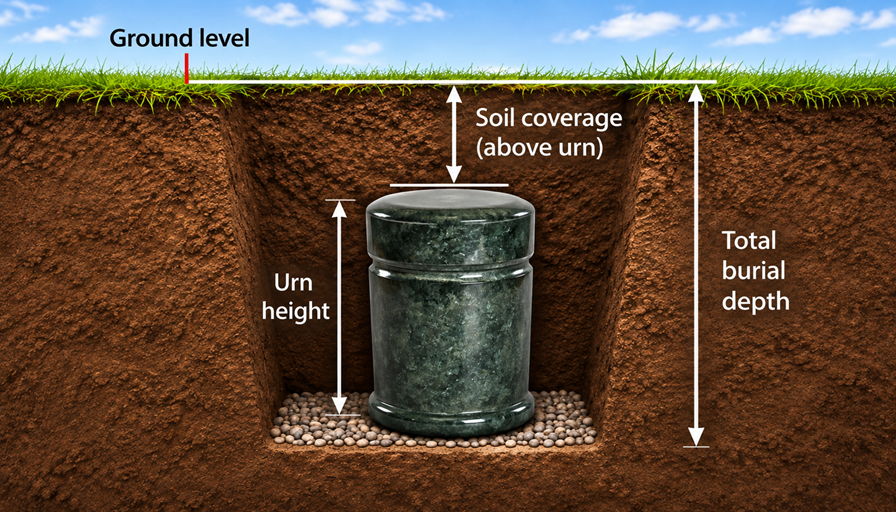
Three measurements are particularly relevant when preparing a grave for a cremation urn.
1. Total Excavation Depth
The total excavation depth is the vertical distance from the original ground level to the bottom of the prepared burial opening.
This is the measurement described by Galway City Council's minimum depth of 60 cm.
2. Soil Cover Above the Urn
Soil cover is the distance between the top of the urn or protective container and the finished ground level.
A grave opening that is 60 cm deep does not automatically provide 60 cm of soil above the urn.
The actual soil cover depends on the container's height, its position in the opening and any bedding or other required preparation.
3. The External Height of the Urn
The urn's external dimensions affect the underground space needed.
If an urn is placed inside an outer casket or protective vault, the dimensions of that outer container must also be considered.
This is why the burial authority should confirm both the excavation requirements and the type of container permitted.
Example: A 20 cm Urn in a 60 cm Opening
Imagine an urn measuring 20 cm in height, placed directly at the bottom of an opening 60 cm deep.
The distance from the top of the urn to the original ground level would be approximately 40 cm, assuming no additional bedding, outer container or changes to the finished ground level.
This is a mathematical illustration, not a burial-depth recommendation. It does not establish that the arrangement would be permitted in a particular cemetery.
Does Burial Depth Differ Between Cemeteries and Family Graves?
The arrangements can differ depending on whether the urn is being placed in a dedicated ashes plot, an existing family grave or another permitted burial space.
Dedicated Cremation Ashes Plots
A designated urn plot is intended for the burial of cremated remains.
These plots may have specific external dimensions, permitted urn sizes and requirements for preparing the grave opening.
For example, Galway City Council specifies that cremated remains must be placed in an appropriate grave space or designated urn plot.
Before ordering an urn, ask the cemetery for the maximum container dimensions and the required burial arrangements.
Existing Family Graves
Some Irish cemeteries and graveyards permit cremated remains to be placed in an existing family grave, subject to approval.
The cemetery must consider earlier burials, the condition of the grave, available space and the relevant permissions.
An existing coffin may affect where and how another burial opening can be prepared.
If the family grave has been described as full, our separate guide to burying ashes in a full family grave in Ireland explains what families should ask the burial authority before making arrangements.
Churchyards and Historic Graveyards
Parish graveyards and older burial grounds may have their own procedures for approving further interments.
Historic grave structures, existing burials and access restrictions may affect whether an urn can be placed in a particular location.
The organisation responsible for the burial ground should confirm what is permitted and which measurements apply.
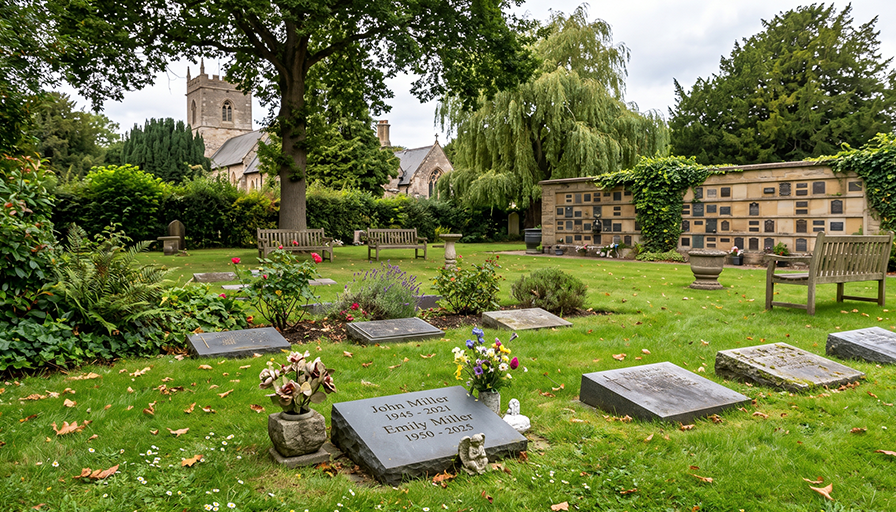
Can Ashes Be Buried Above an Existing Coffin?
In some Irish cemeteries, cremated remains may be interred in a grave that already contains a coffin.
However, the presence of physical space does not automatically mean another interment is permitted.
The burial authority must consider the position of earlier burials, ground conditions, the grave's authorised capacity and any applicable burial rights or permissions.
There is no single excavation depth that guarantees an urn can be placed above an existing coffin.
Families should ask the cemetery or graveyard manager to assess the specific grave rather than attempting to determine the available burial space themselves.
Can Cremation Ashes Be Buried in a Private Garden in Ireland?
A private garden burial raises different questions from interment in a managed cemetery.
Before considering this option, establish who owns the land, whether any restrictions apply and whether the proposed burial is legally and environmentally appropriate.
Do not assume that the depth requirements published by Galway City Council or another cemetery also govern private gardens.
The following matters deserve particular attention:
- Permission from the landowner and any applicable property restrictions.
- Underground services, drains and water pipes.
- Groundwater, nearby water sources and flood risk.
- Soil stability, erosion and drainage.
- Future gardening, landscaping or construction work.
- Access to the resting place if the property changes ownership.
- Keeping a reliable record of the burial location.
If there is uncertainty about the legal or environmental position, contact the relevant local authority or seek qualified advice before proceeding.
A published cemetery depth should not be used as a substitute for checking the requirements of a proposed private burial site.
Does a Biodegradable Urn Need a Different Burial Depth?
Not necessarily. Burial depth depends primarily on the burial ground's rules and the planned interment arrangements, rather than on whether the urn is described as biodegradable.
Biodegradable urns can be made from paper, natural fibres, wood and other materials designed to break down under suitable conditions.
However, their intended uses differ. An urn designed for water placement is not automatically suitable for burial in soil.
The time required for an urn to decompose depends on the material, construction, moisture and other environmental conditions.
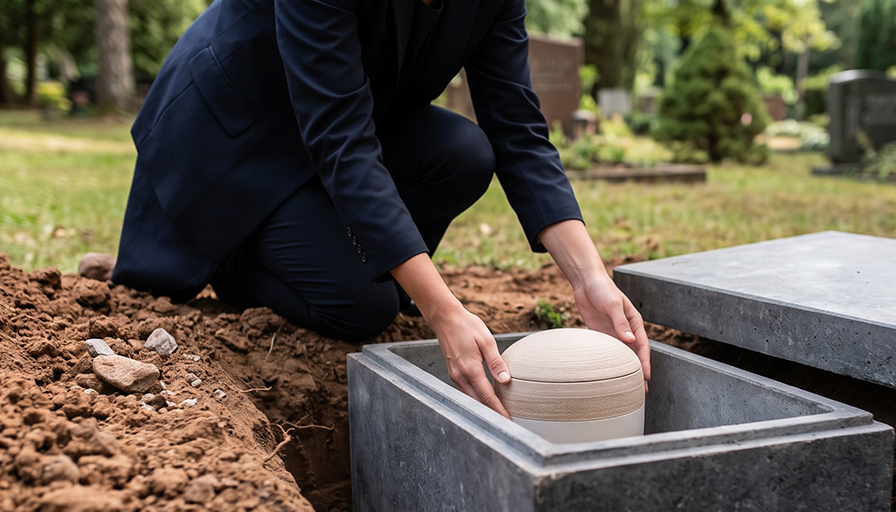
If you are considering a natural burial, you can explore our biodegradable urns for ashes.
Always check the individual product's intended use and confirm that its material and dimensions are accepted by the burial authority.
Are Ceramic, Metal or Stone Urns Suitable for Burial?
Not every decorative urn is designed for underground placement, even when the material appears durable.
Some burial grounds may accept different container materials, while others require specific construction standards or impose restrictions.
Galway City Council's code, for example, specifies a suitable, sufficiently strong urn approved by the council.
Before purchasing an urn for burial, ask the cemetery to confirm:
- Which urn materials are accepted.
- The maximum permitted external dimensions.
- Whether a protective outer casket or vault is required.
- Whether the container must be sealed.
- Who is responsible for opening and closing the grave.
For a broader explanation of the arrangements, see our guide to urns and ashes in cemeteries in Ireland.
Why Coffin Burial Depth Rules Should Not Be Applied Automatically
Burial-depth information intended for coffins may not apply in the same way to cremated remains.
Traditional graves and dedicated urn plots can have different dimensions, placement arrangements and safety requirements.
Galway City Council's code illustrates this distinction by setting out specific requirements for cremated remains separately from its provisions for coffin burials.
When contacting a cemetery, make clear that you are arranging the burial of cremated human remains in an urn, rather than a coffin interment.
That distinction helps the administrator provide the relevant measurements and instructions.
Burial Depth Checklist for Families in Ireland
Before arranging an interment, ask the cemetery or burial ground manager these questions:
- What excavation depth is required? Confirm the rule specifically for cremated remains.
- Is there a minimum soil-cover requirement? Ask how it is measured.
- What urn dimensions are permitted? Obtain the maximum external height, width and depth.
- Is a protective container required? Check whether a casket or vault affects the measurements.
- Which urn materials are accepted? Confirm whether biodegradable, ceramic, wooden or metal urns are suitable.
- Can the urn be placed in an existing grave? Ask about previous burials, authorised capacity and required permission.
- Who prepares and closes the grave? Confirm whether cemetery staff or approved contractors must carry out the work.
- Can the requirements be confirmed in writing? Keep a record before choosing the urn or finalising the ceremony.
Frequently Asked Questions About Ashes Burial Depth in Ireland
How deep should cremation ashes be buried in Ireland?
The required depth depends on the burial ground. Galway City Council specifies a minimum excavation depth of 60 cm for cremated remains in its designated cemeteries, but this is not a nationwide rule.
Does the 60 cm rule apply throughout Ireland?
No. The figure comes from Galway City Council's Cemetery Code of Practice 2023. Other cemeteries and graveyards may have different requirements.
Is burial depth the same as soil cover?
No. Excavation depth is measured from ground level to the bottom of the opening. Soil cover is measured from the top of the urn or outer container to the finished ground level.
Can cremation ashes be buried without an urn?
That depends on the burial ground's rules. Galway City Council requires cremated remains to be placed in a suitable urn. Other locations should be consulted about their own requirements.
Can I dig an urn grave myself in an Irish cemetery?
Do not assume that you can. Managed cemeteries may restrict excavation to authorised staff or approved contractors. Galway City Council's code expressly provides for graves to be opened and closed by cemetery operatives or approved contractors.
Who should I contact about burial depth?
Contact the cemetery or graveyard manager. For a local authority cemetery, start with the relevant council. For a parish or privately managed burial ground, contact the responsible organisation directly.
Choosing a Suitable Resting Place
Choosing where to bury the ashes of someone you love is a personal decision. Understanding the burial requirements can help make the arrangements clearer and prevent unexpected difficulties.
In Ireland, the most important step is to confirm the rules of the actual cemetery, graveyard or burial ground before selecting an urn.
The excavation depth, amount of soil cover, permitted urn dimensions and requirements for another interment may differ between locations.
Once those practical details are clear, families can focus on creating a resting place that feels meaningful and appropriate for the years ahead.
If you need information about the dimensions or intended use of a particular urn, please contact legendURN. We can help with product information, while the burial ground remains responsible for confirming what is permitted.
Official sources and scope: This article concerns the Republic of Ireland, not Northern Ireland. It draws on the Irish Government's burial regulations guidance and Galway City Council's Cemetery Code of Practice 2023, particularly Sections 2.2 and 2.3 on page 3. The Galway measurements are local requirements, not national minimum depths. Always obtain current confirmation from the relevant burial authority before making arrangements.